How to write a video script, with a 30-second example
A video script is what people hear and what they see at the same moment. How to write one for a short marketing video: the one moment, the word count, the two columns, and what changes when the voice is generated.
Brayden Blackwell7 min read
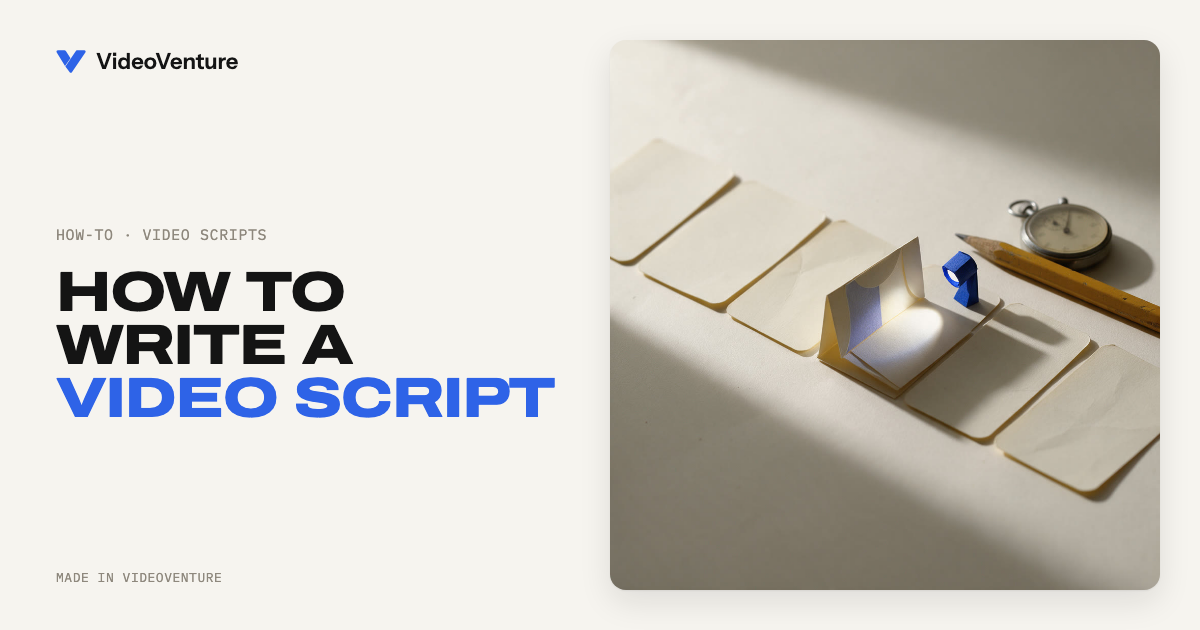
A video script is the words people hear and what they see at the same moment, written beat by beat. To write one for a short marketing video, decide the one moment the viewer should remember, write for the ear at about two and a half words a second, put a picture beside every line, then read it aloud against a timer and cut until it fits.
That's the whole method. The rest of this post is the detail that makes it work, and a 30-second example you can copy.
I didn't always know any of this. When I tried writing scripts in high school, I didn't really understand structure, and they kept coming back with a note that I needed to go see the teacher. It was only later, once I started reading more about it, that I noticed most good scripts have a lot of structure in common. It's the same structure AI turns out to be really good at finding.
Start with the one moment
Every script needs one named peak. It's the line, the reveal or the image the whole video builds to. Decide it before you write anything else. A hook gets people in and a call to action tells them what to do, but the peak is what they remember and repeat.
A marketing friend of mine put it best: "People need something to hang their hat on." If a video never has that one moment, there's nothing for anyone to think about later. When it does, they remember it, and they're more likely to go and look into your product. It doesn't have to be grandiose, and it'll be different for every video.
Name it in a sentence, like "the price drops to zero", "the before shot cuts to the after" or "the founder says why they started". Then every line before it is setup, and every line after it is the landing.
How many words fit
I've made thousands of videos, and this is what fits in 30 seconds:
- 55 to 65 words reads calm and unhurried.
- 70 to 75 words is the middle ground. Not sleepy, just a natural pace.
- 80 words and up gets you an upbeat, brisk delivery.
- Past 90 words sounds rushed and chaotic. Cut.
That lines up with voiceover studios like Killerspots, which plan a 30-second spot at 70 to 80 words, and with the 125 to 150 words a minute that WeVideo and Biteable recommend. You get an ear for it once you've made enough videos, and we built it into VideoVenture too. Every voice in the studio is measured for how fast it talks, and spoken lines are sized at that natural middle pace, about two and a half words a second.
At a natural pace, that scales to:
- 15 seconds: about 35 words. One idea, no setup.
- 30 seconds: about 70 words. A problem and its payoff.
- 60 seconds: about 140 words. Room for one proof point or a short demo.
- 90 seconds: about 210 words. An explainer, still with one message.
Write to a little under the length, so the read has room to breathe and the music has a beat to land on.
A word count is only a start. When we ran the same 36-word script through three voice providers, the reads came out 16% apart in length. Time the actual take, not the page.
Write it in two columns
A video script has two columns, one for what the viewer hears and one for what they see while they hear it. Writing both at once stops the most common mistake, a voiceover that describes what's already on screen. If the picture shows the product, the words can say why it matters.
The two columns are also your shot list. Each row is a shot, and its length is how long the line takes to say.
The template has four parts for every beat.
- Time: where the beat starts and ends, like 0:00 to 0:04.
- Hear: the exact words, or "music only".
- See: the shot, and any text on screen.
- Note: what lands on the music, or what the beat is for.
A 30-second example
An illustrative script for a piano tuner called Larkspur Piano Service. The business is made up; the structure is the point. The peak has no words at all. It's a chord that finally rings true, landing into silence.
0:00 to 0:04
- Hear: "That one key's been off since Christmas."
- See: a finger presses a key. The note wobbles, sour.
- Note: the hook, about the viewer's piano, not the business.
0:04 to 0:14
- Hear: "We come to your house, tune all eighty-eight keys, and fix the sticky ones while we're there. Most visits take about an hour."
- See: a tool case opening, the lid propped up, hands working on the strings.
- Note: the proof. The words say what the pictures can't, which is where, how much and how long.
0:14 to 0:20
- Hear: nothing. The music drops out.
- See: the tuner steps back, and a kid sits down at the bench.
- Note: the quiet beat before the peak.
0:20 to 0:25
- Hear: one clean chord, and nothing else.
- See: small hands play it. The tuner smiles.
- Note: the peak, landed into silence.
0:25 to 0:30
- Hear: "Larkspur Piano Service. Book a tuning."
- See: the name and web address over the open lid.
- Note: one call to action, said once and shown once.
That's 36 words for 30 seconds, about half a natural pace, because eleven seconds belong to the quiet and the chord. It reads short on the page and right out loud.
Writing for a generated voice
More scripts now get read by a generated voice than by a person in a booth, and that changes a few things none of the usual guides cover.
- Write numbers and names the way they're said. "Twenty-nine a month", not "$29/mo". Symbols, abbreviations and web addresses get read in ways you didn't plan.
- Punctuation is your direction. A comma is a short breath, a full stop a longer one. If a line runs together, split it.
- Listen before you rewrite. The same words come out differently from take to take. When one take sounds right, keep it and adjust its pauses rather than generating another and hoping.
Captions, music and one voice
Captions cover every word or none. On social, plenty of people watch with the sound off, so captions often carry the script. Captioning only the key lines makes the rest look missing. Short sentences caption cleanly; long ones wrap into blocks nobody reads.
Let the music carry some beats. When the track is doing the work, say less. Land one or two moments exactly on the music, like the peak on the biggest hit, or let the music drop out so it lands in silence. When I watch a video and its big moment does that, it hits so much harder, and I can tell someone made it thoughtfully and carefully. Cutting every line on every beat sounds like a template.
One voice of authority. Either a narrator tells the story or a character speaks on camera, never both. Two voices compete for the viewer's trust.
Mistakes that sink short scripts
- More words than the runtime holds, so the read rushes.
- Two messages in one video. Pick one; save the other for the next video.
- Opening on the brand instead of the viewer's problem.
- A call to action that's buried, or asked twice.
- Writing for the eye, with long sentences, lists and words nobody says out loud.
- A voiceover that describes the picture instead of adding to it.
Can AI write a video script?
Yes. It's good at the first draft, like the structure, options for the hook and versions at different lengths. Left alone, it's weaker at the parts that make a script work. It writes too many words, opens with a generic hook, and gives every line equal weight instead of building to one moment. Tell it the peak and the runtime, then cut what it gives you.
In VideoVenture, a video with a narrator or people speaking starts with the script. You settle the words first, and the plan for the shots follows, so the pictures are cut to the script rather than the other way round.
That's the part I love. I can go in with a half-baked idea, and depending on how much I've given it, it either fleshes the idea out fully or runs with what I have and turns it into something structured a business would be happy to post. You just need to come with an idea, or work one out with AI, and it can help turn what's in your head into something with that careful polish.